
Champlin City Directory Collections by Source
Champlin’s historical directory record is spread across a public digital collection, a library branch, a Minnesota Historical Society finding aid, and one rural landowner source. Each answers a slightly different question. Hennepin’s digitized material can produce a name or address lead when the OCR works. The MNHS telephone run identifies a Champlin-specific sequence of print, Yellow Pages, and microfiche issues. The 1914 atlas reaches an earlier township landscape. For a result that matters, save the title, issue year, page image, and collection identifier, not just a search snippet.
| Collection | Coverage shown | Keeper | Access route |
|---|---|---|---|
| Hennepin digitized directory records | Varies by title and community | Hennepin County Library digital collections | Online search, metadata, and page images |
| Champlin telephone-directory run | 1960-2005, with item and type gaps | MNHS Gale Family Library | Finding aid, print, Yellow Pages, or microfiche |
| Atlas and Farmers’ Directory | 1914 | Hennepin County Library | Public digitized item and page images |
| People, census, and newspaper records | Varies by record set | MNHS, HCLIB, and archives | Online index, catalog, or staff-assisted research |
The record does have gaps. The research did not verify a complete Champlin city-directory run at the branch, and the MNHS finding aid shows changes in format by year. A Yellow Pages issue is business evidence, not a full household list. A missing name may also reflect OCR failure, a minor, a non-head of household, or a city and year outside the collection.
Searching Champlin City Directory Images
Hennepin County Library’s digital collections include directory and telephone material, maps, newspapers, and other local records. The city index also lists Champlin as a discovery route. Search a person, business, address, or category only as a lead, then open the page image and retain its title, year, and page number. Directory fields vary by publisher and issue, so a result may show an address, occupation, classified listing, or only a telephone entry.
The collection search captured in this image is a useful entry point for Champlin directory work.
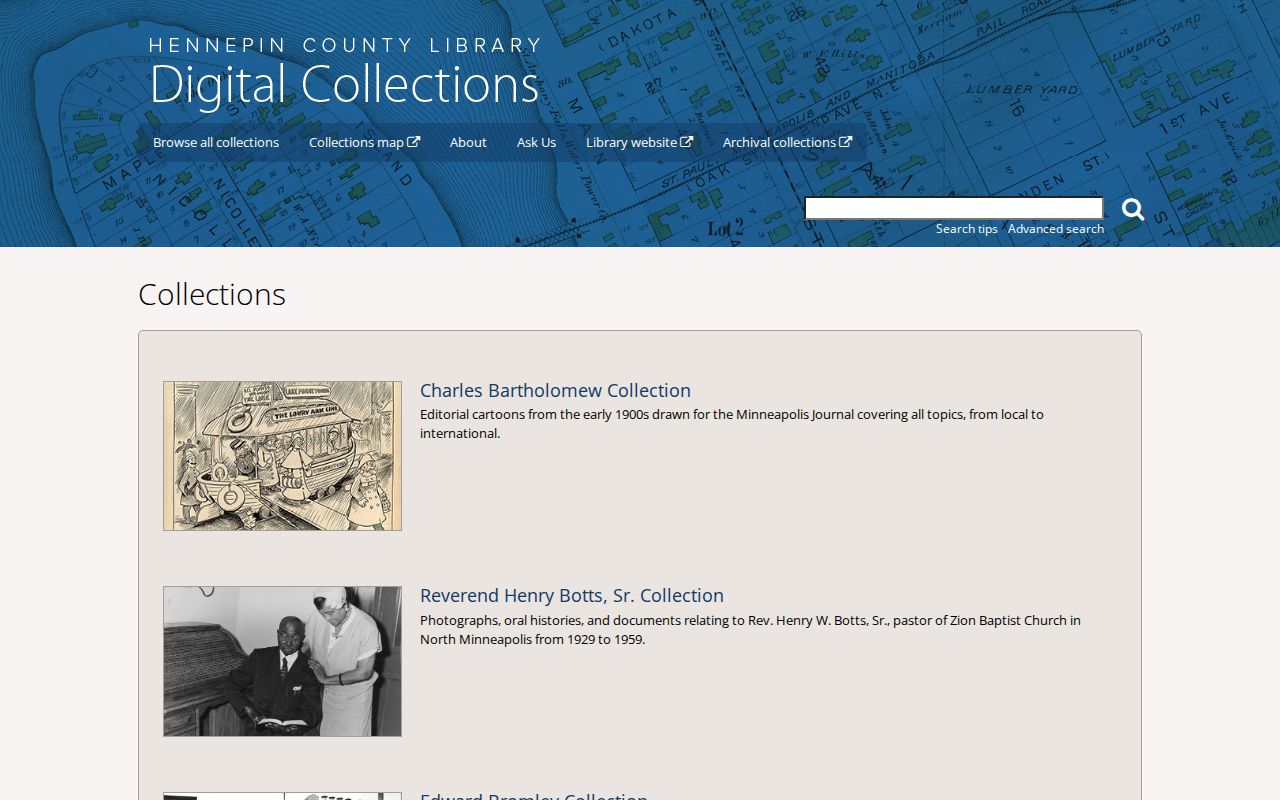
Page images matter because abbreviations and OCR errors can change a surname or street reading. A no-result search is a reason to try a spelling variant, browse the title, or ask library staff for the catalog location, not proof that a household was absent.
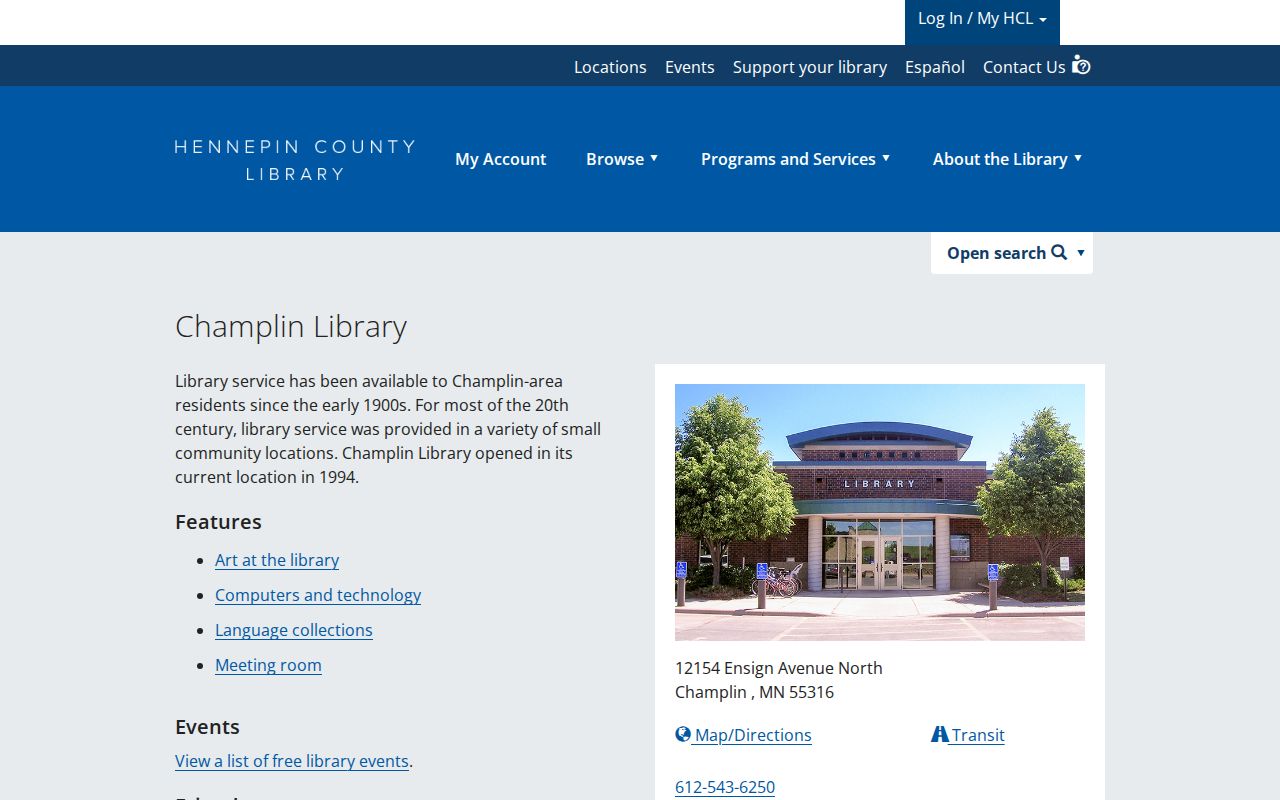
Champlin Library, at 12154 Ensign Ave N, gives a local starting point for catalog and staff help. Its posted hours are Monday, Wednesday, Friday, and Saturday from 9 a.m. to 5 p.m., Tuesday and Thursday from noon to 8 p.m., and Sunday closed. Call 612-543-6250 or verify the schedule before visiting. The branch page does not promise a dedicated local-history room or a complete on-site directory shelf, so request a specific title or subject rather than assuming it is available there.
The library location shown in this image is the local access point, not evidence that every historical volume is housed there.
Library staff can route a request toward local history, newspapers, yearbooks, obituary leads, genealogy resources, or telephone directories. Those companion sources help test a directory finding without turning one listing into a conclusion.
Champlin Telephone Directories at MNHS
The MNHS Hennepin County telephone directories finding aid describes a collection beginning in 1889, but the Champlin-specific run documented there is 1960 through 2005. It contains print volumes, Yellow Pages, and microfiche, with gaps and type changes. That distinction matters. A full telephone directory can provide a subscriber or household clue, while a Yellow Pages issue tracks business categories and advertisers instead.
| 1960 | Print directory, shelf 2167. |
|---|---|
| 1961 | Yellow Pages only, shelf 2168. |
| 1962 | Yellow Pages 2169 and full directory 2170. |
| 1987 | Microfiche 557, print 2216, and Yellow Pages 2217. |
| 2005 | Item 3748 and Yellow Pages 3749. |
The finding aid screenshot shows the collection route behind that year-by-year trail.
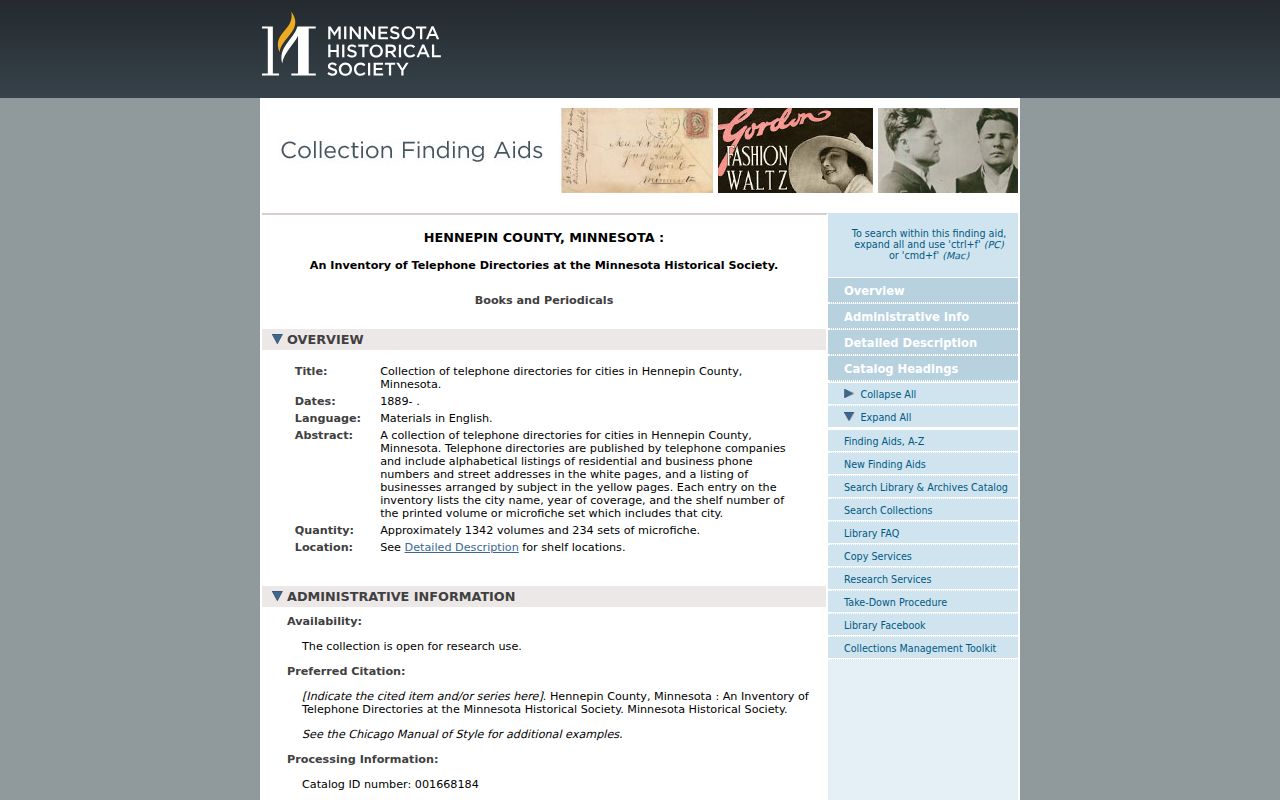
Use the precise year and item type in a request or visit. The listed shelf and microfiche numbers are collection controls, not address data. They make a result reproducible for a librarian or researcher.
Reading a Champlin City Directory Entry
A directory entry should be transcribed as an item of evidence, not expanded from memory. The research inspection did not reproduce a complete Champlin page or verify one fixed entry layout. For that reason, capture what the page actually shows and label the listing type. A telephone subscriber may be a household head, a business contact, or a former number. The entry does not establish that every person at an address was listed.
| Exact name | Preserve spelling, initials, and any name variation from the page image. |
|---|---|
| Address or number | Record it exactly, including unit, street form, or rural wording. |
| Listing details | Note a telephone number, occupation, business, or category only when the issue shows it. |
| Source control | Keep the title, year, page, item number, and whether it is print, Yellow Pages, or microfiche. |
| Listing class | Mark it as residential, business, classified, or reverse-street material when identifiable. |
- Criss-cross directory
- A street-order section of a directory, when the issue includes one. It is useful for an address trail but is not verified for every Champlin item.
- Householder index
- An index that commonly centers a household head or subscriber. It can leave out minors and some other household members.
- Abbreviation key
- The volume’s explanation of its short forms. Capture it before interpreting an unfamiliar address, occupation, or listing mark.
Champlin City Directory Clues Before 1971
Older research needs more than the present city name. The state boundary record describes a 5,602-acre consolidation approved on March 18, 1970, and the city’s planning history says the City of Champlin was created in 1971 by consolidating the village and township. Search Champlin Township and Village of Champlin alongside the modern city label. Rural routes, farm names, land descriptions, and county references may appear where a current street number does not.
The 1914 Atlas and Farmers’ Directory of Anoka County and Eleven Northern Townships of Hennepin County is the key early example. Anderson Publishing Co. created it, Webb Publishing Co. of St. Paul published it, and the digitized item includes Champlin Township. It is an atlas and farmers’ landowner source, not a complete directory of every resident.
The public item page shown here provides the source metadata for this early-directory clue.
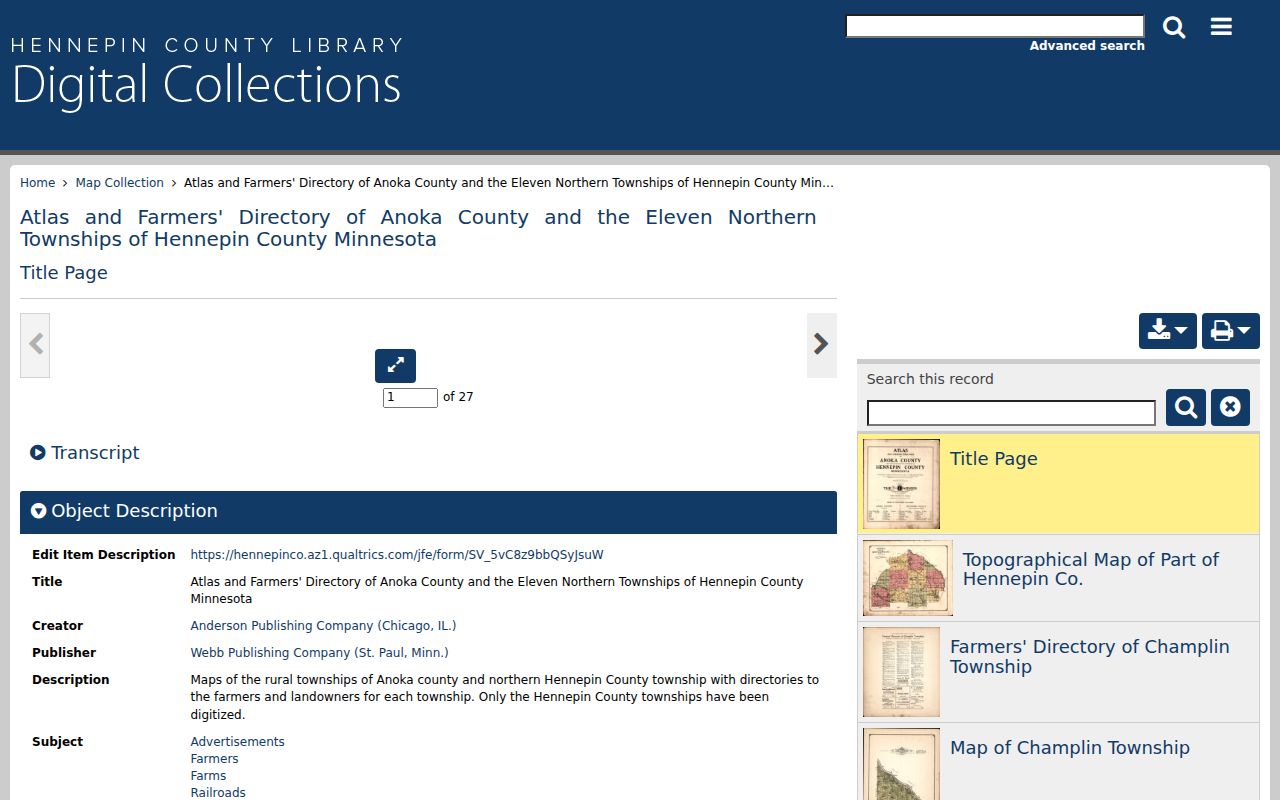
Use its township and map context with deeds, plats, and census records. Do not supply a person, acreage, spouse, or house number from the metadata alone because the research inspection did not open a full page image.
Tracing Families with Champlin City Directories
A directory sequence can fill the years between census snapshots, but it needs a two-source check. Start with the earliest supported name or address, then move forward one documented issue at a time. Changes in spelling, street, listing type, or nearby community are research notes, not answers by themselves. Pairing a directory with a deed, census schedule, newspaper notice, or vital-record index can show whether the same household is still being followed.
- Locate a full directory issue for the surname or address and save its year, page, and item type.
- Follow the entry into later Champlin issues, recording moves and name variants exactly as printed.
- Check a reverse or street-order section only when that issue actually contains one.
- Pair the directory year with an appropriate census or a dated newspaper, deed, or map source.
- Label the result as directory-listed, census-enumerated, recorded, or reported instead of merging the evidence.
A disappearance can reflect a move, death, unlisted household member, incomplete coverage, or a change to Yellow Pages-only material. For a single-address investigation that continues through deeds and household evidence, use the Champlin Previous Residents route rather than forcing the collection evidence to answer every question.
Beyond Champlin City Directory Shelves
Some useful companion collections are not a verified Champlin run. The Minnesota Genealogical Society city-directory microfilm project has 96 rolls and 12 fiche, mainly for Minneapolis, St. Paul, and Duluth through 1920. It can help with a metro move or a surname comparison, but it should not be represented as a complete Champlin collection. The same caution applies to licensed genealogy databases: the Champlin branch page did not verify a specific current subscription or a dedicated local archive.
Newspapers can bridge a directory gap with a dated obituary, legal notice, move, business advertisement, or civic notice. MNHS research services and HCLIB provide routes to that material. Across the county line, the Anoka County Historical Society has newspapers, census material, burial information, maps, and archival holdings, but it is relevant only when a family, newspaper, business, or jurisdiction actually crosses into Anoka County. Its published request terms include about 15 free initial minutes, then $20 per hour, with no microfilm obituary search without an exact death date. Confirm fees and availability before requesting copies.
Requesting Champlin Directory Years
MNHS offers a city-directory search request for one person or business, one city, and up to five years. The request lets the researcher select City Directories, Telephone Books, or both. The published price is $20 for both types, including digital email or scanning, with a $5 nonrefundable processing component. MNHS lists a typical response time of three to four weeks and says delays may reach 12 weeks, so confirm terms before ordering.
MNHS says the service returns a research response rather than a page copy, and not every place or year is available. If the directory route ends, try the MNHS People Records Search, historical newspapers through HCLIB or MNHS, and the Anoka County Historical Society only when a family or record truly crosses the county line. Champlin parcels and most local records remain Hennepin County matters.
Note: Keep the original jurisdiction wording in every citation because a township label is not automatically the same as today’s city boundary.